|
Oct. 13, 2026: Opposing CSO payment to Cambridge/Somerville: Letter in opposition to $25 million assessment upon Randolph to pay for Charles River/Mystic River Combined Sewer Overflow project From: jgordon@randolph-ma.gov Randolph Town Councilor Jesse Gordon To: Linda Orel, staff@neponset.org, UpdatedCSOControlPlan@aecom.com, jesse@jessegordon.com Emailed Oct 13, 2026, 8:02 PM Mailed to: MWRA Attn: Draft Updated CSO Control Plan 2 Griffin Way Chelsea MA 02150 October 13, 2026 To the MWRA and watershed groups, I'm opposed to Randolph funding the Cambridge-Somerville CSO project -- and to the watershed groups, I think you should be opposed too! I oppose Randolph contributing through the MWRA, on equity grounds. I do support Somerville and Cambridge conducting their CSO projects, on the environmental grounds cited in the watershed group letter below. But the wealthy cities of Somerville and Cambridge should not burden Randolph and other environmental justice communities with this cost. It is literally a redistribution TO wealthier communities FROM less-wealthy communities! The MWRA is a fine organization, but they have NOT helped Randolph financially with our water needs! We share a reservoir with two other MWRA communities, Braintree and Holbrook (i.e. we do not use MWRA water). Those three towns must pay millions to clean up PFAS infiltrating our reservoir (a half million a year, for many decades). It would be great if MWRA charged all the other communities to pay for our PFAS cleanup -- but they're not going to! Those three towns, and most of the South Shore MWRA communities, are in the Neponset watershed and/or the Weymouth Fore watershed. The MWRA should exclude those communities, and charge only the communities in the Charles watershed and the Mystic watershed. Or charge less to communities in other watersheds. Furthermore, our tri-town area should be excluded because we are not part of the MWRA Water Communities. The example the watershed groups cite below benefitted "Canton, Westwood, Norwood, Dedham, and Stoughton" -- all our South Shore neighbors -- and all are MWRA water communities! Our three towns are excluded from your list because we have funded our own water supply for decades-- without any help from MWRA, as my PFAS example illustrates. The watershed groups pose this question: "Is the Distribution of CSO Control Costs Equitable?" -- the answer is "no". To be equitable, the CSO cost distribution should include two factors:
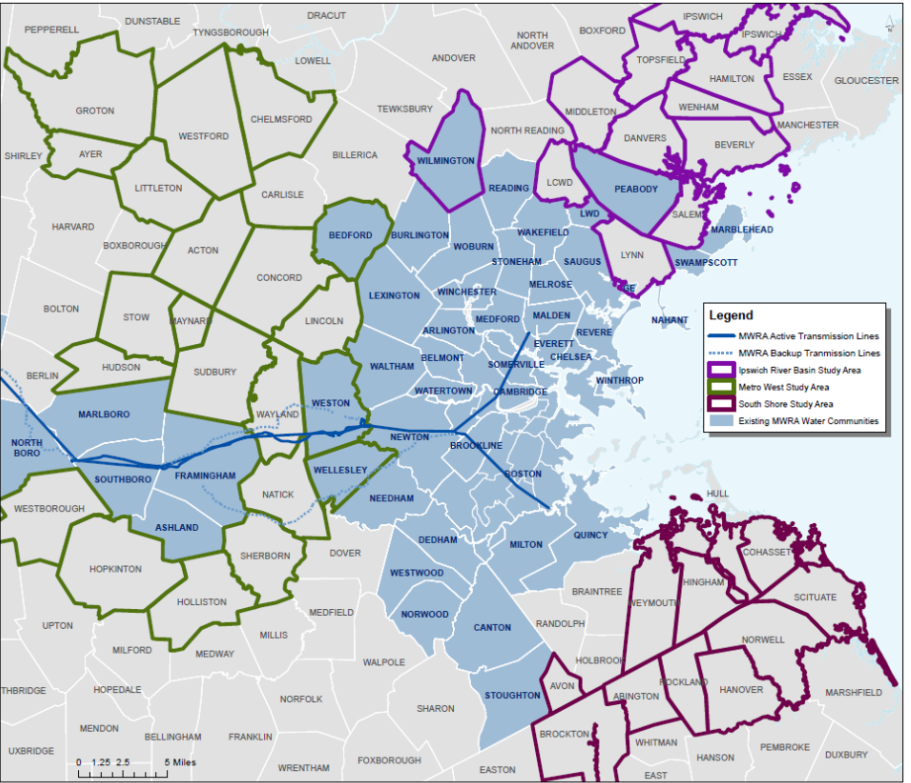
I'm looking at the MWRA Water Community map (reproduced above from mwra.org), and the vast majority of towns DO meet one of those two criteria. I advocate that THOSE communities share the CSO cost. I believe the Town of Randolph has already sent the MWRA a letter saying much the same as this letter -- and we voted last week to send a letter from the Town Council too. The vote was unanimous that it is inequitable to charge Randolph. You can view the discussion and vote, on RCTV at http://108.20.229.83/internetchannel/show/3564?channel=2 from 1:43 to 1:51, including my comments on inequity. I have worked with both the NepRWA (most recently on signage along the Neponset Greenway) and the Charles watershed group (when I lived in Cambridge and Waltham). I would be happy to address both groups in person to try to persuade you to support a more equitable cost-sharing such as I propose above. An alternative equitable cost-sharing would be this: --The tri-towns pay a share of the CSO project, and the MWRA funds our PFAS cleanup. In other words, make our three towns a beneficiary of MWRA water projects, and then it's equitable that we contribute to MWRA CSO projects. Our estimate of PFAS cleanup might cost $500,000 per year, for "GAC Filter Recharging". That goes on for decades because PFAS is leaching slowly out of a Superfund site in Holbrook, and the EPA has declined to further clean up the PFAS. Our Town Manager reports that the MWRA's proposed CSO cost share for Randolph is a minimum of $25 million over 30 years-- that is a comparable cost to our PFAS. I would advocate FOR Randolph participating in the CSO in exchange for the MWRA permanently funding our tri-town PFAS cleanup. --Jesse Gordon, Town Councilor At Large, Randolph MA
Following is the letter from the watershed groups to the Randolph Town Council:
On Mon, Oct 12, 2026 at 3:01 PM Linda Orel
Dear Members of the Randolph Town Council and Randolph Conservation Commission:
We are reaching out because the Town of Randolph has a role to play in ending raw sewage discharges into the Charles and the Mystic Rivers. Randolph is an MWRA community, and MWRA ratepayers share in the cost of maintaining MWRA-owned infrastructure.
MWRA Investment in Your Community
Here in the Neponset River Watershed, the MWRA has invested heavily in the infrastructure on which the Town of Randolph depends. This includes the creation and ongoing operation of the MWRA's Neponset Valley Relief Sewer, which ended frequent sanitary sewer overflows into the Neponset River, and the complete elimination of combined sewer overflows (CSOs) that once plagued the lower Neponset River, completed in Phase I of the CSO control plan.
More recently, from 2016 to 2021, the MWRA constructed drinking water redundancy improvements to the Southern Extra High System or SEH. This project directly benefited Canton, Westwood, Norwood, Dedham, and Stoughton, and provided emergency backup needs for Sharon and Walpole. The SEH improvements illustrate the benefits of a shared, regional infrastructure system. While this project directly benefited the listed communities, they were only asked to pay 4.14% of the $100+ million in construction costs. The remaining nearly 96% of those costs is being paid by households in other MWRA communities.
The Problem with CSOs and Climate Change
We're sure you will agree that raw sewage should not be tolerated in any waterway in Greater Boston, whether it's the Neponset, Charles, or Mystic. We're even more confident you agree that no one in Greater Boston should be asked to live with sewage-tainted water flooding into their backyard (as now happens along portions of the Mystic because of CSOs.) That's why the Neponset River Watershed Association is joining our colleagues in the Charles River Watershed to support a full cleanup of CSOs on the Charles and Mystic Rivers, as required of the MWRA under the federal Clean Water Act.
Unfortunately, the MWRA's Draft CSO control plan, like the long-term management of the MWRA sewer system in the Neponset Watershed, is greatly complicated by climate change and increasing flood intensity. As a result, the MWRA's proposal to implement "Typical Year" control means that even after a significant investment, by 2070, the frequency and volume of CSOs will be roughly similar to today. That's why we're also advocating for the 25-year level of control as MWRA's only responsible approach. This ensures we won't need another round of expenditures in a few years and guarantees that when streets, homes and neighborhoods flood in 2070, they won't be flooded with sewage.
The CSO Control Plan also involves installing green infrastructure such as rain gardens and trees, to reduce stormwater volumes and therefore, CSOs. Here in the Neponset River Watershed, our flood modeling has shown that our own communities need to undertake these same kinds of green infrastructure upgrades to reduce future flood impacts. It would be enormously beneficial to our communities to have the MWRA help plan and lead that process here, and we'll be urging the MWRA to step up to take a greater role in flood and stormwater management across the region since stormwater, flooding, and wastewater management are fundamentally inseparable in any practical sense when considering climate change.
Is the Distribution of CSO Control Costs Equitable?
Lastly, we want to address the cost of the CSO Control Plan. While CSO control is expensive, those capital costs are spread over a long time period, are manageable relative to incomes in our region, and represent a very small share of expected MWRA capital expenditures over the next 40 years.
Misinformation is publicly circulating implying that communities like Randolph are being asked to shoulder 60% of the cost. This is not true. About 42% of the total project cost will be paid directly by Somerville and Cambridge for improvements to infrastructure that they own. Some 58% of the costs are for improvements to MWRA-owned infrastructure, but Boston, Cambridge and Somerville are large members of the MWRA system and will contribute substantially to the MWRA side of the ledger. In all, the three cities will be contributing 63.5% of the total cost (based on current sewer flows) with all other MWRA communities contributing 36.5%. Randolph's contribution will be approximately 0.79%. While that's still a substantial sum, it's a small price to pay considering other infrastructure projects like the SEH where others are contributing 96% of the cost for improvements that directly benefit Randolph.
Conclusion
We hope you will support a plan that allows the communities of the Charles and Mystic watersheds to benefit from a CSO-free river just as Neponset communities do. If the Town of Randolph decides to comment on the MWRA CSO control plan, we hope you will acknowledge that no one in Greater Boston should be subjected to sewage pollution, and that Randolph receives significant benefits funded by other communities as a member of the MWRA. The Charles River Watershed Association requests that you consider the language in this template comment letter as you draft a response.
Thank you for your consideration.
|
|||||||||||
| Randolph Democratic Town Committee, co-chair Jesse Gordon, 52 West St, Randolph MA 02368 Home > Events | |